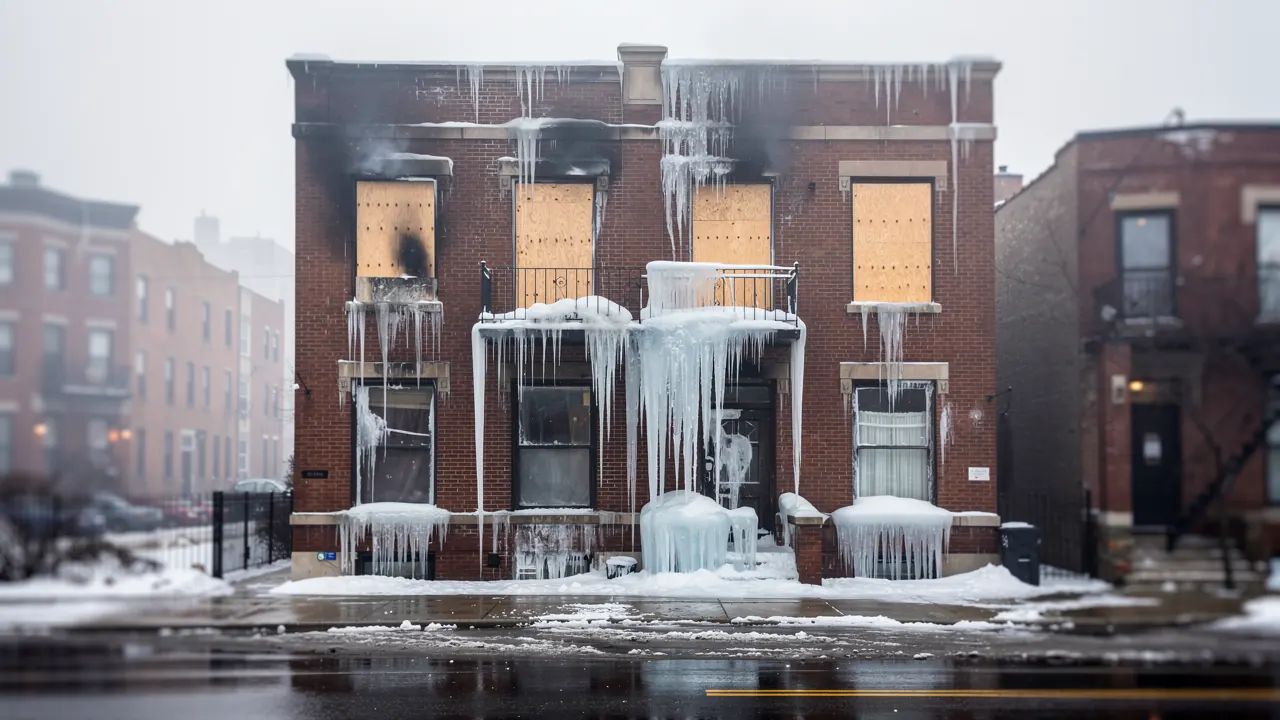
Chicago water and fire restoration is one trade for a reason: almost every structure fire is also a water event. Putting out a single room can take hundreds of gallons — a standard CFD engine line flows roughly 150 to 180 gallons per minute, and larger fires get multiple lines. That water doesn't stay in the burned room. It runs through floorboards, down plaster walls, and into the units and stories below, so the family two floors under the fire often has more damage than the flat where it started. If that's your building, call (331) 373-2437, describe what burned and what got soaked, and get connected with independent local restoration crews who handle both halves of the problem.
Firefighting water soaks everything the flames missed. Describe what burned and what got wet, and get a crew that handles both sides of the loss.
Call (331) 373-2437 NowFire Damage Restoration in Chicago: Two Kinds of Damage at Once
Chicago's vintage housing shapes how fire damage spreads. In pre-war brick multi-units, an open cockloft — the shared attic void running under one roof — can let fire travel over the top of party walls, which is why crews open ceilings well beyond the visible burn. In the city's older frame workers cottages, balloon framing gives flames an uninterrupted path inside wall cavities from basement to attic. Either way, the pattern is the same: char and smoke go up and out, while the suppression water goes down. A restoration crew has to map both — the burned material that comes out, and the wet material that can be saved if it's dried fast.
Water Damage from Firefighting: The Half People Underestimate
Firefighting water behaves like a burst main running for twenty minutes. Saturated plaster and lath, buckled hardwood, ceilings sagging under trapped water — often in rooms the fire never touched. Winter adds a Chicago-specific twist: water that soaked walls during a January fire can freeze inside the cavities and on the facade, hiding the true moisture picture until it thaws weeks later. That's why extraction and metered drying should start as soon as the department releases the building — the same urgency covered on the emergency water removal page. Standing suppression water also wicks soot deeper into materials, making cleanup harder every day it sits.
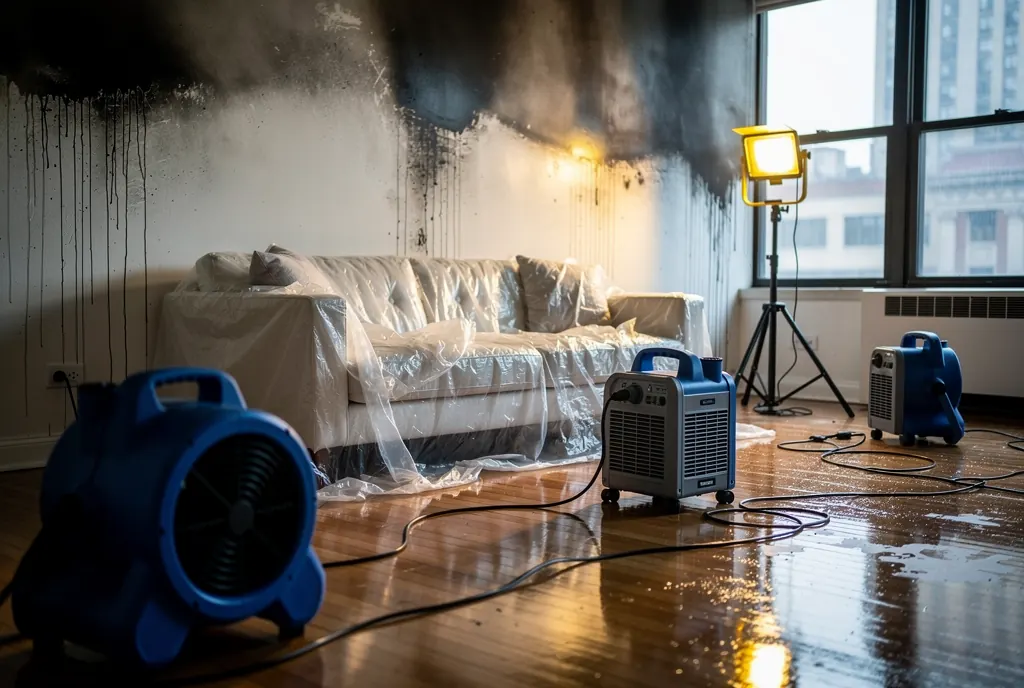
One call sorts out the order of operations — board-up, water extraction, smoke cleanup — with a restoration crew that works fire losses.
Call (331) 373-2437 NowSmoke and Soot Cleanup in Chicago Homes
Soot is not one substance. A kitchen grease fire leaves a smeary protein residue; burning plastics and synthetics leave a dry, acidic film that starts etching metal fixtures and glass within days. Smoke also rides air currents into closets, ductwork, and neighboring units that show no fire damage at all. Proper smoke and soot cleanup means testing what kind of residue you have, cleaning or sealing surfaces in the right order, and addressing odor at the source — not masking it. Done wrong, the smell comes back with the first humid week.
Board-Up to Rebuild: How the Sequence Actually Runs
Restoration after a fire follows a fixed order, and skipping steps costs money:
- Securing the building — board-up and roof tarping. Chicago's building rules require fire-damaged openings to be secured, and insurers expect it as loss mitigation.
- Water extraction and structural drying, before demolition decisions are made.
- Soot and smoke cleanup, including contents triage — what's cleanable versus a total loss.
- Controlled demolition of charred and unsalvageable wet material.
- Rebuild.
To be direct about who does what: this site is a free call-connection service, not the contractor. The crews who respond are independent local businesses — you hire them directly and should verify their license and insurance. What the call does is get your situation in front of pros who cover your neighborhood and handle combined fire-and-water losses, instead of you cold-calling down a list while the building sits wet.
Insurance and First Steps
Fire claims are usually covered perils, and that includes the firefighting water — but documentation drives the payout. Photograph everything before touching it, keep damaged contents until the adjuster sees them, and log every conversation. The insurance claims guide explains how water-related line items get handled, and the after-water-damage checklist applies to the soaked floors below the burn.
The fastest move is a call. Dial (331) 373-2437, say what burned, what got wet, and whether the building is secured — and get matched with a Chicago-area restoration crew today. The rest of what this service covers is on the homepage.
What you throw away, your claim can't count. Talk to a pro first about what gets documented, what gets cleaned, and what has to go.
Call (331) 373-2437 Now